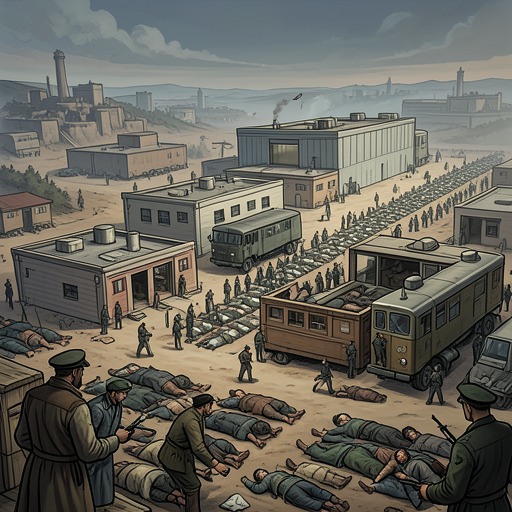
Nazi authorization for the “Final Solution”
The Zone of InterestNazi authorization for the “Final Solution” is presented as a decisive turn in the Nazi extermination policy, but not as a single command that specified every later method. In a conversation with Angelus Thomsen in the Tiergarten, Konrad Peters traces how a high-level authorization met competing bureaucratic demands and escalating pressure from officials in occupied Poland. His account makes the policy’s development both hierarchical and improvised: authority came from above, while the means and targets of mass murder expanded through the system below.
The authorization and its chain of authority
Peters dates the beginning of what he calls the crime without a name to July 31, 1941, describing the date as the zenith of Nazi power. In his account, Adolf Eichmann and Reinhard Heydrich drafted a letter and sent it to Goring, who returned it with his signature. The letter conveyed Adolf Hitler’s wish for a total solution and gave authority to begin. Peters summarizes its practical significance as permission to act on preparations already underway: manpower had been assembled in the east during July, and the authorization opened the way to proceed.
The conversation does not present the letter as a fully detailed blueprint for the later killing process. Peters distinguishes between the authority to pursue a total solution and the evolving decisions about how to carry it out. This distinction matters to the novel’s account of policy formation: a directive from the leadership supplies sanction, while officials and institutions translate that sanction into increasingly radical action.
From deportation schemes to the murder of women and children
Peters suggests that the first contemplated answer may still have been expulsion on a vast scale. After an anticipated quick victory over Russia, Jews might have been dumped in remote, cold territory beyond the Urals or in the Arctic Circle; the proposed outcome would have been extermination through exposure and deprivation rather than immediate mass shooting. In this account, the plan’s form remained unsettled even as the regime’s lethal purpose was taking shape.
Pressure from below helped close off that imagined territorial solution. Officials in Poland faced the addition of millions of Jews to the population under their control and protested that they could not manage the numbers. As the prospect of sending deportees to distant territory receded, Peters describes another push toward more extreme measures. By August or September, the decisive expansion was to kill not only men, whom German forces had already been murdering for months, but women and children as well. The shift marks a change in the scope of the violence, not its beginning: the killings of men were already underway before the policy was extended to whole families.
Competing institutional demands
The account of the authorization sits alongside Thomsen’s view of the administrative machinery that acted on such decisions. At the camp, he describes pressure from the Economic Administration Head Office to increase the available labor force for the munitions industries, set against pressure from the Reich Central Security Department to dispose of as many evacuees as possible. The two demands pull in opposite directions: preserve people who can be exploited for work, or remove those whom the security apparatus defines as a threat. Thomsen’s exasperation at the suggestion that able-bodied mothers be worked in a boot factory at Chełmek brings the conflict down to a specific, brutal administrative proposal—and to the problem of separating mothers from their children at the ramp.
This tension complicates any account in which the authorization functions as a simple instruction followed uniformly by every office. The narrative instead shows bureaucratic priorities colliding while remaining enclosed within a shared system of persecution. Economic usefulness can postpone a person’s murder without offering protection; security policy can press for removal even when labor departments seek to extract more work. The authorization provides authority for extermination, while institutional competition shapes how people are classified and treated along the way.
Methods, consequence, and responsibility
Peters rejects the idea that the industrial apparatus of killing was necessary to the outcome. Gas chambers and crematoria, he tells Thomsen, were means to accelerate the process, economize resources, and spare the killers’ nerves. Bullets and pyres would also have been sufficient, because the perpetrators already possessed the will to kill. He cites the Einsatzgruppen’s murders of well over a million people by shooting to underline the point: the technology altered the speed and organization of murder, not the underlying intention. Industrial methods are therefore presented as instruments of efficiency and a way to distance killers from the violence, not as the source of the decision to exterminate.
The novel’s later outcomes place this policy within a broader reckoning over participation and responsibility. Paul Doll was moved to a clerical post in the Inspectorate of Concentration Camps in June 1943, reinstated as a commandant in May 1944, and eventually tried at Nuremberg before being delivered to the Polish authorities. In his final statement, he acknowledged grave sin against humanity; he was hanged outside Bunker 11 in Kat Zet I on April 16, 1947. Separately, thirteen IG Farben executives and managers were convicted at Nuremberg in July 1948, with Suitbert Seedig and Rupprecht Strunck receiving prison sentences that included responsibility for slavery and mass murder. These postwar judgments do not stand as direct consequences of the July 1941 letter, but they extend the novel’s examination from authorization to the people and institutions implicated in the system that followed.